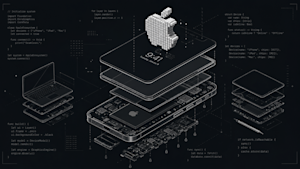
Apple’s new Siri AI is more than just a smarter assistant — it's a new enterprise app layer
편집자 요약
Apple은 WWDC 2026에서 새 Siri AI를 단순한 음성 비서가 아니라 iPhone, iPad, Mac, Apple Watch, Vision Pro 전반에서 앱·데이터·업무 액션을 연결하는 시스템 인터페이스로 제시했습니다. 기업 개발자는 App Entities, Spotlight semantic index, App Intents, App Schemas, View Annotations를 통해 앱 콘텐츠와 기능을 Siri 및 Apple Intelligence에 노출할 수 있습니다.
맥락
이번 변화는 기업용 앱이 별도 chatbot을 구축하지 않아도 자연어 기반 검색, 요약, 업데이트, 실행 기능을 제공할 수 있음을 의미합니다. Apple 생태계에서 업무 앱의 가시성과 사용성이 OS 수준 AI 레이어에 의해 좌우될 가능성이 커지면서, 엔터프라이즈 개발자의 앱 설계와 데이터 모델링 방식에도 변화가 예상됩니다.
본문
Apple’s new Siri AI, unveiled yesterday at Apple's annual Worldwide Developers Conference (WWDC 2026), may look like a consumer product story on the surface. But for enterprise developers and IT leaders, the bigger news from WWDC26 is that Apple is turning Siri into a systemwide AI interface for apps, data and workplace actions across iPhone, iPad, Mac, Apple Watch and Vision Pro, as revealed in the WWDC26 Apple Intelligence developer guide.In other words, if your company offers an application on Apple devices, whether it's served on iOS mobile device or Mac, the new Siri AI may force you to change how that application is discovered, served, and its contents and workflows made available to end users. Enterprise developers can expose app content through App Entities, make it available to Apple’s Spotlight semantic index, define actions through App Intents and App Schemas, and map onscreen user interface elements to app objects through View Annotations.That makes Siri AI much more than a voice assistant. Apple is positioning it as an AI-powered app action and content-discovery layer built into its operating systems.Siri becomes an app action layerFor enterprise developers, the shift could be significant. A business app that properly adopts Apple’s new frameworks could let users ask Siri to find, summarize, update or act on app content without the developer having to build a separate chatbot interface. Apple says App Intents, its existing framework for exposing app actions to system features like Siri and Shortcuts, is the path for connecting apps to Apple Intelligence and Siri AI, while schemas make app content and actions usable through natural language.In practical terms, that could apply to customer records in a CRM, open tickets in an IT service desk, project tasks, invoices, calendar events, documents, expenses, notes, messages or field-service records. Instead of opening an app, searching manually and clicking through menus, an employee could ask Siri to act on the specific object they are viewing or retrieve a related item from another app.Spotlight becomes the enterprise search hookApple says in its WWDC26 Apple Intelligence guide that entity schemas contribute app content to the Spotlight semantic index, while intent schemas let users take action on that indexed content without developers defining a rigid list of command phrases. Apple also says the new View Annotations API lets developers map views to entities so users can refer to what is onscreen conversationally — for example, “summarize this customer thread,” “add this invoice to my expenses,” or “follow up on this task tomorrow.”That is an important distinction from earlier voice-assistant integrations, which often required narrow command structures and explicit invocation phrases. Apple is instead giving developers a way to describe an app’s data and capabilities so Siri, Spotlight and Shortcuts can use them through the system.Developers get testing tools for Siri and app actionsApple is also adding AppIntentsTesting, a framework that validates App Intents through the same infrastructure used by Siri, Shortcuts and Spotlight without requiring UI automation. That matters for enterprise software teams because natural-language app actions need to be testable, repeatable and reliable before they are trusted in production workflows. It also gives developers a path to include Siri and Spotlight behavior in ordinary testing pipelines instead of treating assistant integration as a manual demo feature.The result is a clearer developer mandate: if an app wants to show up well inside Siri AI, it will likely need to expose its data, actions and onscreen context through Apple’s system frameworks. For enterprise SaaS vendors, that could become an important part of Apple-platform competitiveness, especially in categories such as productivity, collaboration, CRM, project management, finance, design, knowledge management, healthcare, logistics and field operations.Apple expands its model stack for developersApple is also using WWDC26 to expand its AI developer stack beyond Siri. The updated Foundation Models framework gives Swift developers access to Apple’s on-device models, Apple models running through Private Cloud Compute and third-party model providers that conform to Apple’s Language Model protocol. That gives developers more flexibility than a single Apple-only model path. Apple says in its Apple Intelligence developer guide that the framework now supports multimodal prompts, Vision tools, dynamic model profiles and evaluations. In theory, an enterprise app could use an Apple on-device model for private or lightweight tasks, call Apple’s Private Cloud Compute for heavier reasoning, or plug in an outside provider such as Claude, Gemini, an open-source model or a company-controlled model through Apple’s model-provider interface.Core AI brings custom models onto Apple siliconApple is also introducing Core AI, an operating system-level framework f
댓글
토론
다음 읽을거리 추천

Cohere open-sources a coding agent that runs on a single H100

Researchers trained an open source AI search agent, Harness-1, that outperforms GPT-5.4 on recalling relevant information